

The Supply Chain Resilience Operating System
The best supply chains do not avoid every disruption. They respond faster because the rhythm is already clear.
For supply-chain leaders, planners, sourcing teams, and operations teams
The published artifact
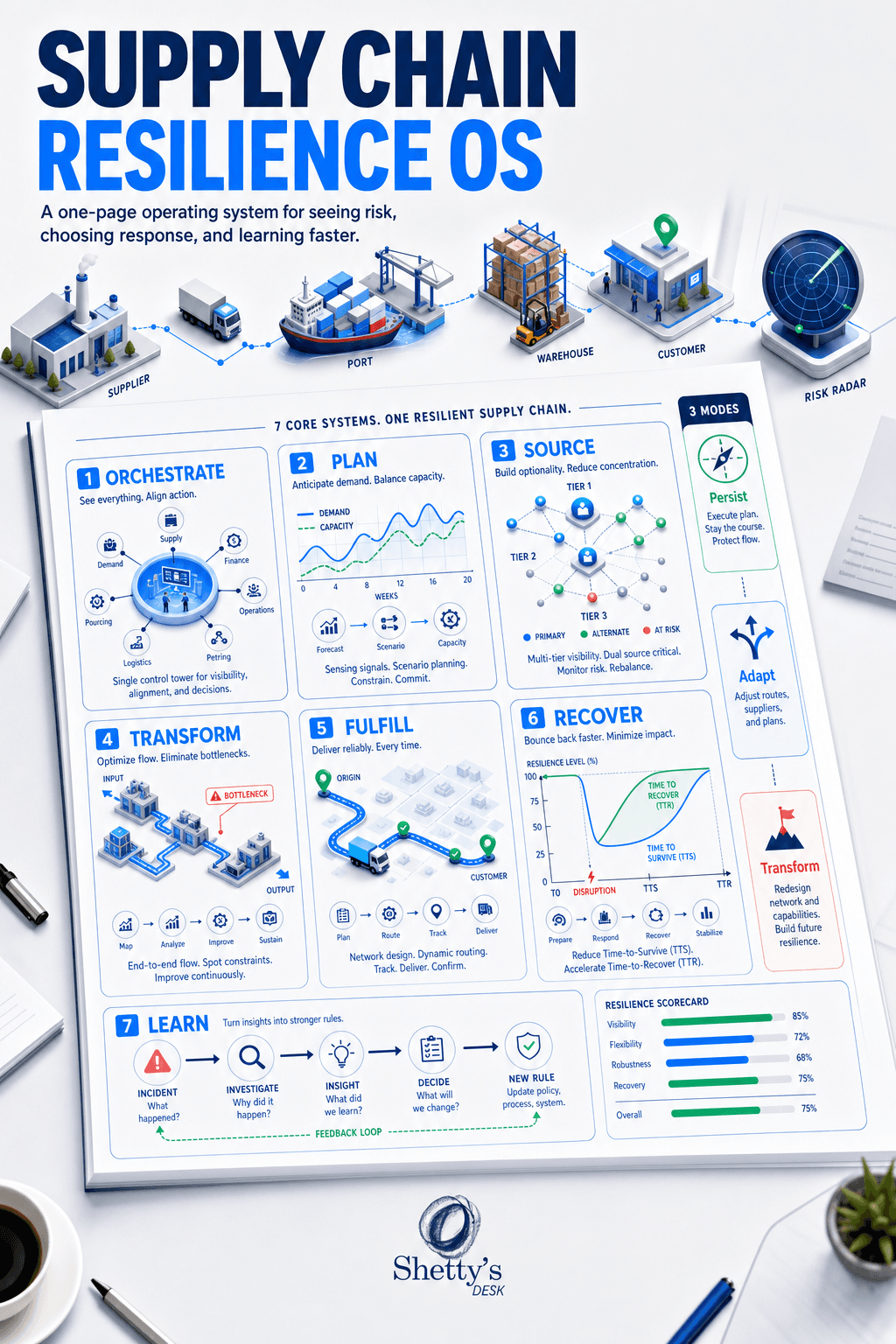
Decision architecture
How to read the artifact
Follow the operating logic in order. Each step should leave a clearer piece of evidence, question, or decision for the review.
- 01
Trust the signal
Name what changed, when it changed, and which evidence the response team will use.
- 02
Expose the constraint
Recheck capacity, bottlenecks, inventory, and the assumptions that no longer hold.
- 03
Create optionality
Compare suppliers, routes, allocations, and response choices before escalating one answer.
- 04
Protect and recover flow
Make survival time, recovery time, customer priority, and decision ownership visible.
- 05
Change the rule
Convert what the disruption exposed into a stronger trigger, policy, or operating rhythm.
The minimum input pack
- Dated disruption signal and affected nodes
- Inventory, capacity, supplier, and route position
- Customer and service priorities
- Time-to-survive and time-to-recover assumptions
- Named decision owners and available response options
Questions for the next review
- 01What do we trust first?
- 02Which assumption or bottleneck changed?
- 03Which option protects flow with the clearest trade-off?
- 04Who decides, by when, and what will we learn afterward?
Decision boundary
What the artifact prepares, and what the team still owns
This operating system does not predict or prevent every disruption. It gives the team a shared response rhythm, makes trade-offs explicit, and preserves human ownership of the response decision.
Published caption