

The Demand Planning Decision Table
When demand moves, the first question should not be who was wrong. The useful question is what the miss changes.
For demand planners, S&OP teams, commercial partners, and operations leaders
The published artifact
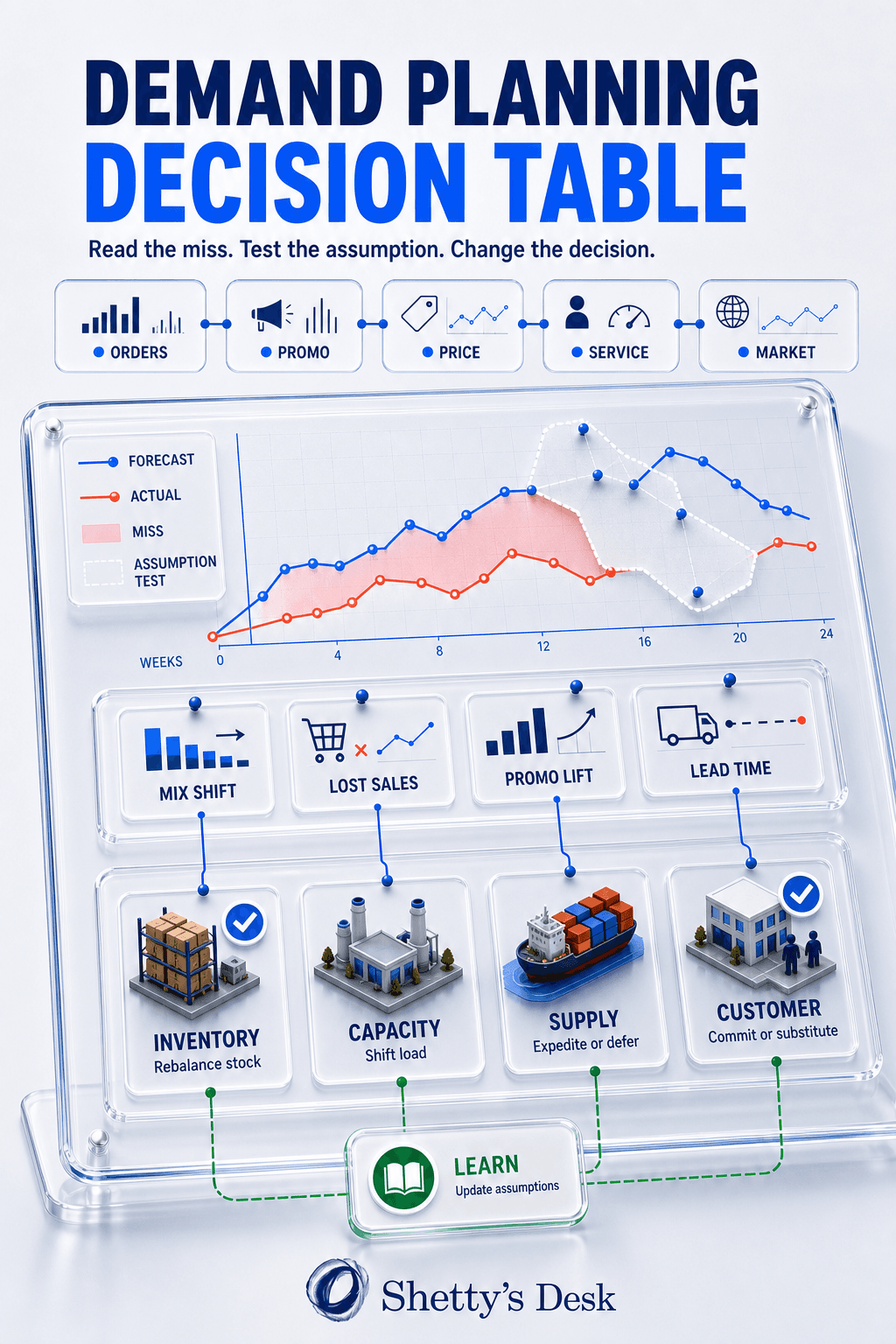
Decision architecture
How to read the artifact
Follow the operating logic in order. Each step should leave a clearer piece of evidence, question, or decision for the review.
- 01
Read the signal
Separate real demand movement from timing, promotion, order, service, and data effects.
- 02
Describe the miss
Show where actual demand moved away from the baseline without turning the review into blame.
- 03
Test the assumption
Identify the belief behind the forecast that should now be challenged or replaced.
- 04
Change the decision
Connect the miss to inventory, capacity, supply, or the customer promise while action is still possible.
The minimum input pack
- Forecast and actual by item, family, customer, and period
- Planner overrides and documented assumptions
- Promotion, order, service, and lifecycle events
- Inventory, capacity, supply, and customer-commitment position
Questions for the next review
- 01What signal changed?
- 02Where did the forecast miss?
- 03Which assumption needs to be tested?
- 04Which operating decision changes next?
Decision boundary
What the artifact prepares, and what the team still owns
The table does not replace the statistical forecast or automatically choose the demand plan. It makes the assumption and downstream decision visible so the business can choose its operating commitment deliberately.
Published caption